

19th June 2025
Own Correspondent
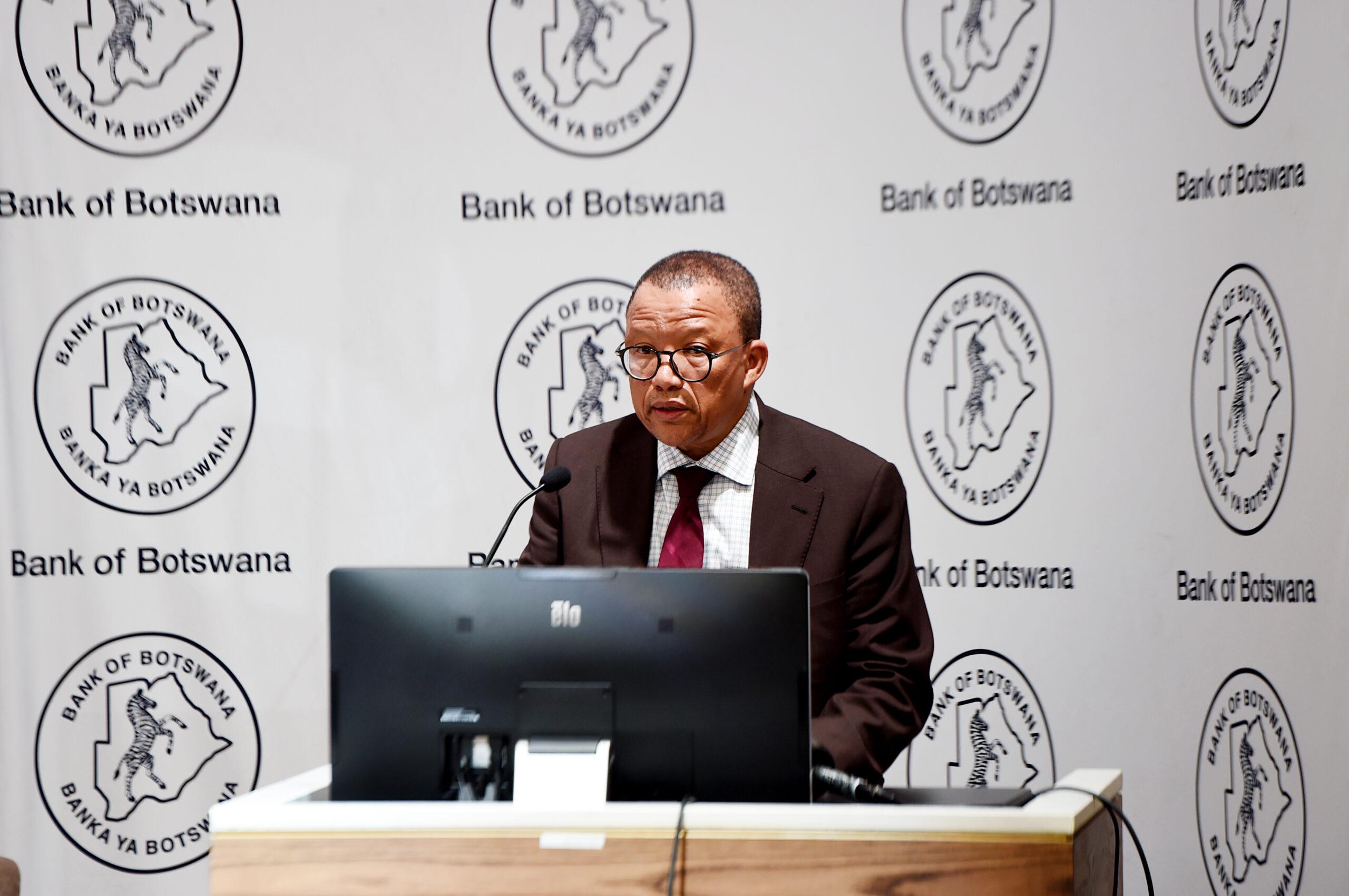
The Bank of Botswana Governor revealed that the domestic economy continues to face challenges related to the inadequate traction of transformation policy initiatives precipitated by the lack of economic diversification and weakening fiscal and external position.
“In an environment where several commercial banks have concentrated funding, externalised a significant part of their balance sheet, as well as uneven liquidity distribution, the current macroeconomic environment has generated a liquidity squeeze,’ said Cornelius K C — Governor of the Bank of Botswana.
He said, “This has triggered a surge in wholesale deposit rates, as the severely affected banks bid aggressively to secure deposits/funding. Consequently, they increased their prime lending rate, with others following as well. This has led to a rise in the cost of borrowing for consumers and businesses.”
As reported by Statistics Botswana, headline inflation has decreased from 2.3 percent in April 2025 to 1.9 percent in May 2025, remaining below the lower bound of the medium-term objective range of 3 – 6 percent. The decrease in inflation between April and May 2025 was mainly on account of the reduction in water tariffs effected in April 2025, which reduced headline inflation by 0.23 percentage points.
The MPC forecasts inflation to remain low into the medium term, averaging 2.7 percent in 2025 and 4.6 percent in 2026. The risks to the inflation outlook are assessed to be balanced.
Of concern to officials, is that this happens in an environment of an accommodative monetary policy stance, necessitated by the prevailing macroeconomic environment, notably, real gross domestic product (GDP) contraction.
Under the circumstances, the Bank has from August 2024 maintained the MoPR at 1.9 percent (accommodative), and slashed the Primary Reserve Requirement from 2.5 percent to zero; increased the term/maturity of the repos with commercial banks from overnight to 7 days; raised the threshold for trading of foreign currency with the commercial banks from a foreign currency equivalent of USD1 million to USD5 million; increased the foreign currency trading margins between the Bank and commercial banks from -/+0.125 percent to -/+0.5 percent; and (e) enhanced monitoring of foreign currency holdings and funds externalisation.
Central Bank officials believe there is a need for augmentation of these measures given the persistence of liquidity constraints and adverse outcomes, as shown by an increase in prime lending rates by commercial banks that are misaligned with respect to both the monetary policy stance and economic growth fundamentals.
The economy is expected to continue to operate below full capacity in the short-to-medium term, though improving marginally into the medium term. This should not generate demand-driven inflationary pressures the Central Bank Governor revealed today.
Inflation is forecast to remain within the objective range in the medium term. Similarly, businesses expect inflation to be within the medium-term objective range, suggesting that inflation expectations are well anchored.
Commercial banks will have access to the Standing Credit Facility(SCF) for their short-term liquidity needs.
The SCF acts as a reliable liquidity backstop for commercial banks and they access this facility at their own discretion. The Bank will continue to monitor the situation, and appropriate measures taken.
In the immediate future, these will include further increasing the threshold for foreign exchange trading, specific prudential measures to encourage depositor diversification by commercial banks, and domestication of foreign exchange currency holdings.
“The Bank has also heightened communication with the banking sector through Bankers Association of Botswana and Banking Committee to try and find solutions to the liquidity issue, not only from the regulator side, but also from the banks’ side,” said Dekop.
Botswana’s real GDP declined by 3 percent in 2024, compared to a growth of 3.2 percent in 2023, indicating that the economy was in a recession in 2024. The 2024 performance was mainly attributable to contraction in the mining sector and generally subdued growth in non-mining sectors.
According to the April 2025 World Economic Outlook, global output is estimated to have expanded by 3.3 percent in 2024 and is forecast to grow by 2.8 percent in 2025 and 3 percent for 2026.
The impact of tariff measures by the United States of America (US) and countermeasures by its trading partners, geopolitical tensions and high levels of policy uncertainty are expected to have a significant impact on global economic activity.
The Ministry of Finance has revised real GDP growth forecasts for 2025 from a 3.3 percent growth to a contraction of 0.4 percent, a similar projection to that of the International Monetary Fund.