19th March 2026
Own Correspondent
The performance of the mineral sector has become increasingly volatile with global demand shifting and depleting fiscal buffers forcing a change in approach to finance development spending officials have revealed.
Phodiso Valashia, Acting BURS Commissioner General, said “Botswana is faced with financing a significantly larger share of its development from domestic revenue, and many citizens and businesses remain sceptical, both about taxation itself and about the ability of the Revenue Service to administer it fairly, efficiently, and consistently.”
He said, “The 2026/2027 Budget marks a decisive shift from reliance to responsibility. It signals a transition away from a model where mineral revenues and public spending carried the economy, towards one where productivity, private sector growth, and domestic revenue mobilisation become the foundation of national development.”
At the end of the third quarter of the current financial year, the country faced a revenue shortfall of P1.519 billion. This is not an abstract figure. It represents services delayed, infrastructure deferred, and opportunities postponed.
Through focused execution, that gap has now been reduced significantly, with over P1.3 billion recovered within a short period. This demonstrates that when systems improve, effort is aligned, and compliance strengthens, results follow.
Botswana’s Value Added Tax gap is estimated at approximately 40%, meaning a substantial portion of revenue that should be funding national priorities is not being realized.
In the 2026/2027 financial year, the Revenue Service will pursue a focused roadmap anchored on four practical pillars. The first is closing revenue leakages by strengthening system integration, tightening controls, and ensuring that every transaction is accounted for and every declaration is verifiable.
The second is full digitalization, including the use of Artificial Intelligence and advanced data analytics to enhance transparency, predictability and reduce discretion.
The third is simplification and speed, so that compliance becomes easier, processes are streamlined, and turnaround times are reduced.
Officials have revealed that in the 2026/2027 financial year, the Revenue Service has been assigned a revenue target of approximately P65.170 billion. This will finance about 70% of Government expenditure and account for close to 80% of total Government revenue.
In practical terms, the functioning of Government will depend largely on what is collected, and what is collected will depend largely on what is declared and paid.
“At present, Botswana’s tax collection-to-GDP ratio stands at approximately 13%. The target is to raise this to at least 18% by the end of the 2026/27 financial year and to exceed 20% thereafter. This is not unprecedented. Countries such as Rwanda, Georgia, and Vietnam have achieved similar transitions through a combination of accelerated digilisation, consistent enforcement, and, most importantly, a strong culture of compliance,” said Valashia.
Between April 2026 and March 2027, the national assignment is therefore clear. Every business must declare fully. Every professional must account honestly.
“Every trader must transact within the system. Every employer must meet PAYE and VAT obligations in full. Every citizen must move from partial compliance to full compliance,” said Valashia.
The inaugural Tax Pitso, convened under the theme, “Shaping Botswana’s Future Tax System: Dialogue for Fair and Sustainable Tax Reform,” was used as a rallying point for compliance.
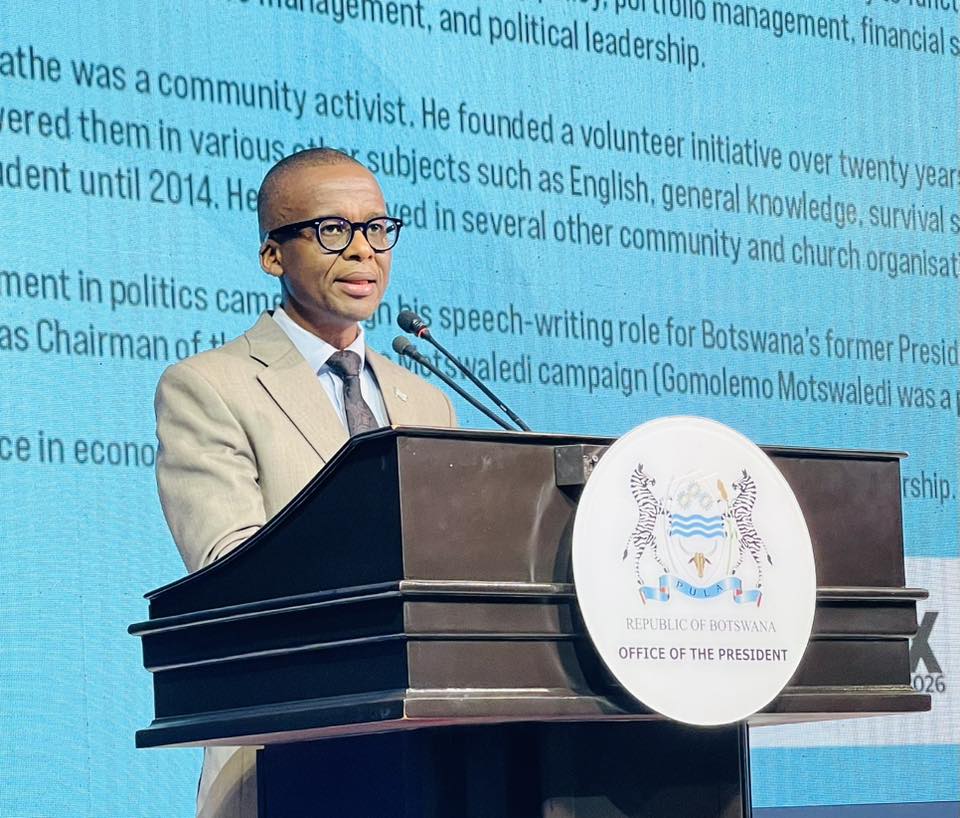
“Our country stands at a crossroads. For decades, our economic model has been anchored on mineral revenues, particularly diamonds. That model has served us well. It has enabled us to build institutions, expand infrastructure and improve the lives of many Batswana,” said Ndaba Gaolathe, Vice President and Minister of Finance in official opening remarks.
He said, “That model is now under strain. Declining mineral revenues, global economic uncertainty and rising demands for social services and infrastructure have placed increasing pressure on our public finances.”
Botswana’s tax-to-GDP ratio stands at approximately 13.4 percent, which is significantly lower than the African average and well below comparable economies in our region.
Gaolathe revealed that this means, quite simply, that we are not yet mobilizing enough of our own national strength to finance the future we all aspire to.
“This reality underscores a simple but critical truth, that if we are to achieve our shared ambition of becoming a high-income nation, we must increasingly finance our development from within,” said Gaolathe.
This requires a tax system that is modern, efficient, fair and capable of supporting our long-term transformation agenda.
The Income Tax Bill proposes a modest adjustment in tax rates, including adjustment of the rate to 27.5 percent for higher income earners and 25 percent for corporate taxpayers.
These adjustments are guided by the principle of fairness and ability to pay. At the same time, new measures will be introduced that expand the tax base while easing compliance.
The introduction of a simplified tax regime for small businesses is designed to support micro and small enterprises, reduce administrative burdens and encourage formalization.
The extension of VAT to digital and remote services ensures that emerging areas of economic activity are appropriately captured within our tax system.
Furthermore, the introduction of real-time transaction monitoring mechanisms will strengthen compliance and reduce tax evasion.