


Sello Motseta
27th April 2026
The official launch of the commercial court will have enabling court rules or legislation providing for different streamlined processes for the effective litigation of commercial cases official revealed during the launch of Commercial Courts.
Regulations setting time standards for filing of pleadings, regulations on adjournments and continuances and the use of pre-trial conferences would be critical to improve investor and business confidence in the courts by reducing delays in case management and backlog as well as improving predictability of court case events.
The presence of legislative reforms would lead to a well-defined scope of the commercial court cases. Generally, literature and practise from other jurisdictions shows that such courts would deal exclusively with cases that involve export and import of goods; carriage of goods by land, sea, air or pipelines, mining; Insurance; banking and financial services, operation of markets and exchanges; purchase and sale of commodities; medical scheme matters; matters arising out of business rescue and insolvency; matters affecting companies; arbitration; delictual cases occurring in a commercial context; contract matters and intellectual property.
Another component of an ideal commercial court would be the availability of appropriate facilities, equipment and adjusted IT structures, a robust stakeholder engagement strategy and the development of qualified personnel through the courts and co-participants (lawyers, business community etc).
A final component of developing a commercial court concerns Alternative Dispute Resolution and mediation in particular which would contribute to court efficiency and reduction of cases that would go through the courts, streamlining trials and reducing costs of litigation.
Chief Justice of Botswana, Justice Gaolapelwe Gee Ketlogetswe, “I stated that we are going to be an innovative judiciary; we are going to be business like in our approach and that we will use the legal resources that we have at our disposal optimally to expand our services. Testament to this was the initiative we took in September 2025 when we launched a Specialised Criminal Court which has greatly assisted us to assess our criminal cases and improve service delivery. This morning, still in that same spirit, we undertake to expand our resources once again and establish a Specialised Commercial Court to improve service delivery and stamp our theme for this year, “The court as a Public Service.”
He said, “The issue of the commercial court has been in the pipelines for many years. My predecessor, His Lordship Rannowane CJ, had during his tenure, established a committee that was tasked with identifying the modalities of the Commercial Court.”
The Administration of Justice was as recent as the year 2023 admitted to the Standing International Forum of Commercial Courts (SIFoCC). A number of our judicial officers have attended the forum’s meetings in order to come to speed with what is happening in the international sphere in regard to Commercial courts and commercial mediation. A year later, the Administration of Justice collaborated with the Ministry of Trade, who with the assistance of the United Nations on Drugs and Crime (UNODC), under the job creation and investment program procured consultancy services for a feasibility report on the establishment of a Commercial Court in Botswana.
SIFoCC’s objectives are, to serve business and markets better, by sharing best practice between courts by courts working together to keep pace with rapid commercial change. Second, to assist courts to work together in order to make a stronger contribution to the Rule of law, and through that contribute to stability and prosperity worldwide. Third, to support developing countries long encouraged by agencies such as the world bank to enhance their attractiveness to investors by offering effective means for resolving commercial disputes.
“According to the World Bank’s “Doing Business” Report, Specialised Commercial Courts bring added value and certainty in litigation. Many jurisdictions are now adopting the establishment of commercial courts. Only 10 countries including Botswana do not have special Commercial Courts in Africa,” said Ketlogetswe.
Uganda show key improvements in the reduced case disposal time. Lesotho, which established commercial courts in 2010 has noted an average case disposal time that reduced from 962 days to 343 days. South Africa which created a commercial court through a Practice Directive in 2018 has also noted fast tracking of cases in the specialised court which led to a recovery of Billions in funds from their financial fraud cases through a more streamlined process than traditional courts. Uganda also saw reduced turnaround times in case disposal from 5 years to 18 months.
Botswana’s commercial cases are currently fragmented and spread across different branches of the judicial system; cases have been defined as either criminal or civil cases. Our civil division has a wide jurisdiction as the courts have been doing a mixture of tort, land, family, contracts, company, financial institutions, intellectual property and many others. These cases are registered under different case types which include Civil Causes (CV case type), Miscellaneous Applications (MA case type) Matrimonial causes (ML) and Civil Appeals (CA).
This has noticeably led to delays in the disposal of cases due to congested court diaries; the feasibility report suggests that commercial cases in this arrangement take an average of 660 days to be completed, advancing a need for the separation of commercial cases from general civil cases to promote their expeditious disposal. The aim is to promote the efficient conduct of litigation of commercial cases in the High Court and to resolve disputes quickly, cheaply, fairly and with legal acuity. Absent the Rules that define a commercial case, selecting commercial cases or cases that have some foundations in commerce is going to be an enormous task that would require a lot of time.
“We have thereby decided that to have the Commercial Court start soon after this launch, all the Civil Causes (CV case-type) will form the baseline for the commercial court; these cases stand at over 5000 currently in the Gaborone/Lobatse Divisions. Over and above the CV case type, the Miscellaneous Applications (MA) will be sieved through to determine cases that are related to procurement as well as Civil Appeals from the Public Procurement Tribunal; such identified cases, which have a bearing on commerce will also be placed before the newly established Commercial Court,” said Ketlogetswe.
He said, “The court is expected to leverage technology and Alternative Dispute Resolution mechanisms and principles in order to expedite dispute resolution in a more cost- effective way. The Rules already provide for Court Annexed Mediation; our intention is to fast track the engagement of a Court Annexed Mediation Administrator in the Commercial Court for efficient resolution of cases.”
The Administration of Justice has identified 12 Judges of the Gaborone and Lobatse High Courts for the immense task of starting this court. 2 of the Judges have been sworn in as temporary Judges of the High Court from the Industrial court. Their appointment is on a continuing basis. They are judges of the Industrial Court who would be doing the work of the High Court.
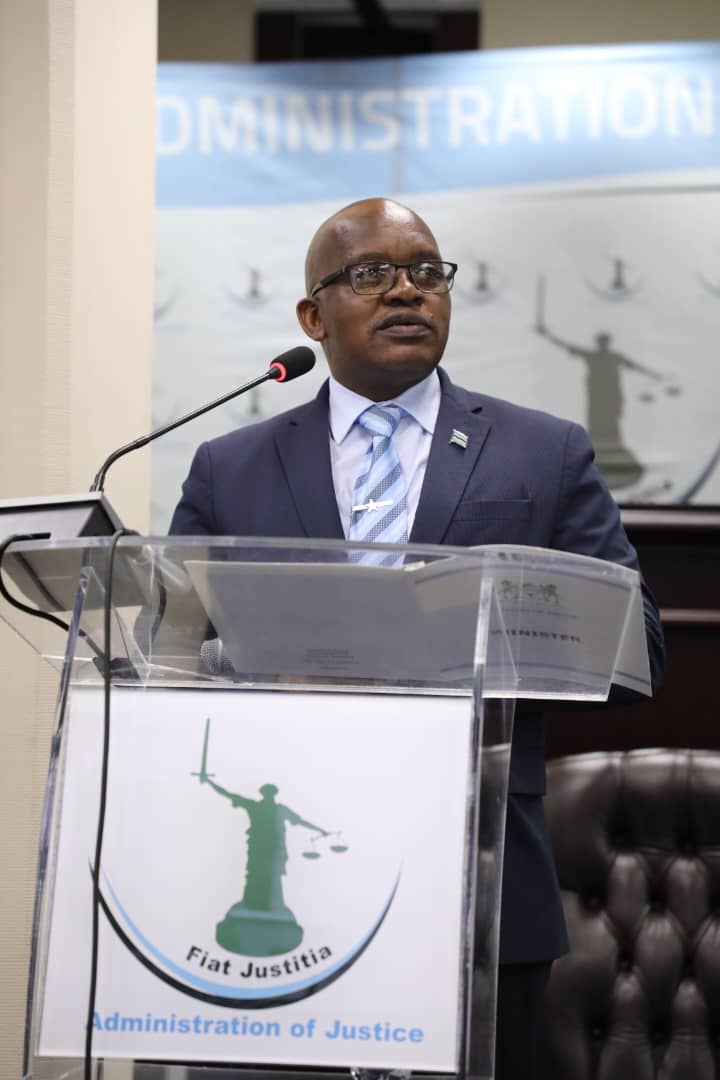
Ramaotwana Nelson Ramaotwana, Minister of Justice and Correctional Services, said “The driving force behind the creation of the specialised commercial court despite resource challenges, is the desire by the AOJ to facilitate the resolution of business and commercial disputes in a quick, efficient and effective manner that ensures that the judiciary in effect becomes a catalyst for economic growth. Today the Administration of Justice takes a decisive step towards modernizing our justice system. The launch of this commercial court is not merely an administrative change; it is a clear statement that our nation is open for business. We recognise that in the fast-paced world of global commerce, time is money.
5. For too long, commercial disputes have been subjected to the backlog of general litigation. By introducing this dedicated platform, the court commits to speed, efficiency, expertise and investor confidence.”
He said, “A robust dispute resolution framework is an integral part of a healthy investment ecosystem and by resolving commercial disputes quickly and fairly, this court would help our local producers and small businesses thrive in the global markets.”
The Judge president of the High Court and the Head of the new Commercial Court Division, Justice Barnabas Nyamadzabo will be sitting in the Gaborone High Court. The Judge President of the Lobatse High Court, Justice Ranier Shakes Busang will however continue sitting at Lobatse. Judge Godfrey Nthomiwa, currently Judge President of the Maun High court, who will in due course sit at the Lobatse High Court division.
Justice Tapiwa Boingotlo Kgangyago, who will be sitting at the Industrial court in Gaborone. His Lordship Bahuma who shall be sitting at the Industrial Court, Gaborone. Judge Dr. Ookeditse Maphakwane of the Lobatse High Court, Judge Reuben Nicolas Lekorwe of the Lobatse High Court, Judge Bugalo Maripe, currently sitting at Maun but bound to move to Lobatse soon, Judge Masilo Mathaka of the Lobatse High Court, Judge Dr. Onkemetse Tshosa who will be sitting in the Gaborone High Court, Judge Onkagetse Pusoentsi of the Gaborone High Court and Justice Mako Abram of the Gaborone High Court.