


30th April 2026
Own correspondent
The Monetary Policy Committee (MPC) of the Bank of Botswana increased the Monetary Policy Rate (MoPR) by 200 basis points from 3.5 percent to 5.5 percent.
This policy decision is intended to strengthen policy transmission. Commercial banks are directed not to increase their Prime Lending Rates (PLRs).
The MPC convened at a time when the global economy continues to experience shifting trade relations, supply chain disruptions, heightened geopolitical tensions and persistent policy uncertainty. Global economic growth is expected to remain subdued in 2026.
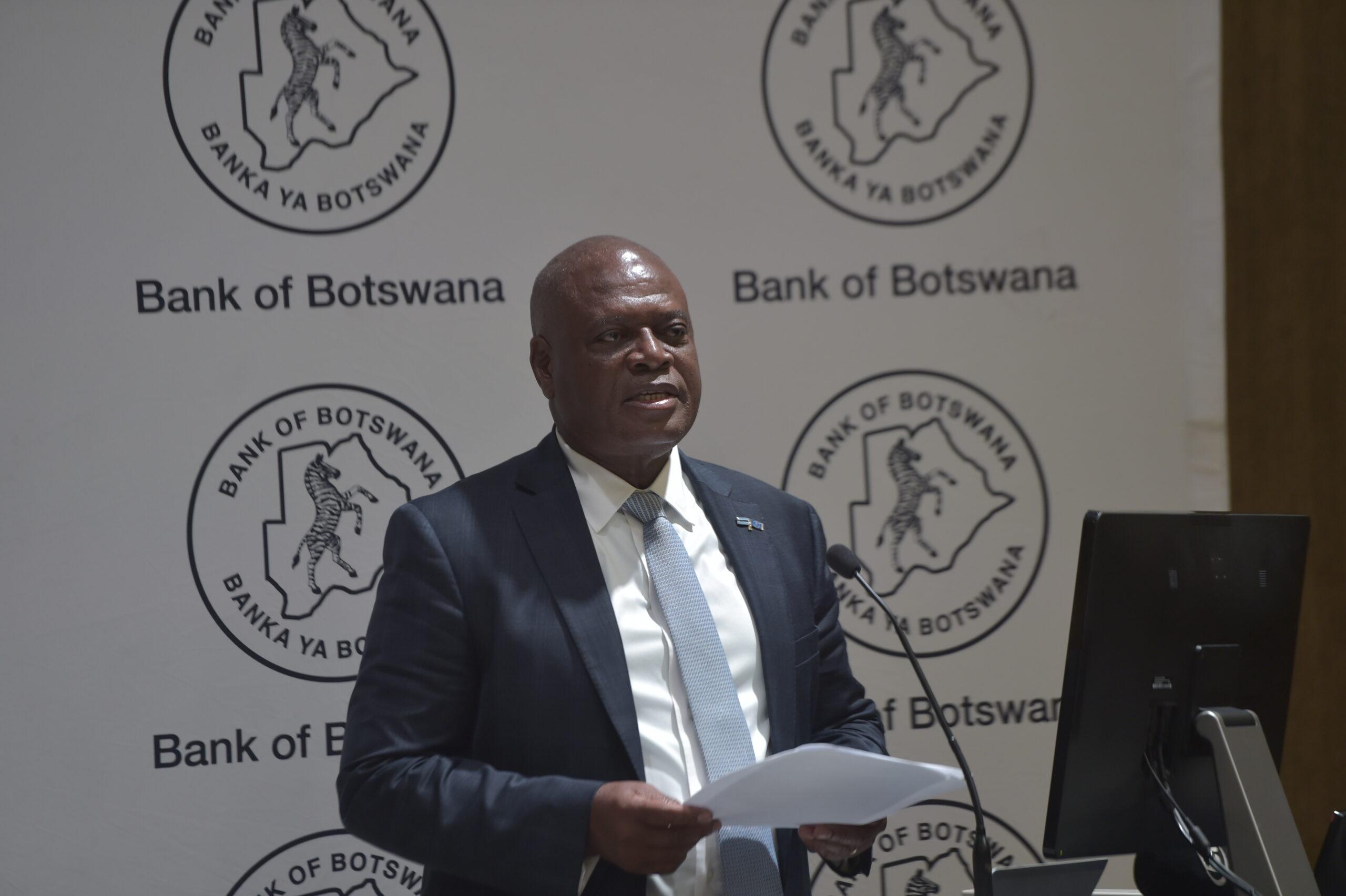
“This is largely due to disruptions associated with the war in the Middle East, which continue to affect commodity markets, inflation expectations and financial conditions. In this context, leading central banks have generally maintained policy rates, while market expectations for rate cuts have diminished, as inflation risks remain tilted to the upside,” said Lesego Caster Moseki, Governor of the Bank of Botswana during a press brief Thursday.
He said, “These external developments have increased the cost of living in Botswana and may undermine the recovery of the global diamond market, thereby weighing down on overall economic performance.”
Real gross domestic product (GDP) contracted by 0.7 percent in 2025, improving from a contraction of 2.8 percent in 2024. The slower pace of contraction was mainly attributable to a smaller decline in diamond mining, while growth in the non-mining sector continued to be modest.
According to the International Monetary Fund’s April 2026 World Economic Outlook report, global economic growth is expected to remain subdued at 3.1 percent in 2026, down from 3.4 percent in 2025. The modest growth reflects heightened uncertainty surrounding trade and constrained fiscal space. Meanwhile, consumption and investment continue to be resilient.
Domestically, the Ministry of Finance projects a recovery to 3.1 percent growth in 2026. This is mainly on account of the envisaged stronger performance in non-mining sectors, as supported by the implementation of economic diversification initiatives under National Development Plan (NDP) 12 and the Botswana Economic Transformation Programme (BETP). Nevertheless, the growth outlook remains subject to downside risks, including livestock disease outbreaks, heightened geopolitical tensions, climate-related shocks and shifting trade patterns.
Headline inflation increased slightly from 4 percent in February 2026 to 4.2 percent in March 2026, remaining within the medium-term 2 objective range of 3 – 6 percent. The increase in inflation was due to higher rate of price increases for Transport and Food & Non-Alcoholic Beverages.
The MPC forecasts inflation to increase significantly in the short term and breach the upper bound of the 3 – 6 percent objective range in the second quarter of 2026, mainly on account of the combined impact of recent increases in domestic fuel prices, public transport fares and medical aid premiums. Inflation is projected to average 8.7 percent in 2026 before easing to 5.6 percent in 2027.
Overall, there is a greater risk of inflation being higher than currently projected due to potential second-round effects stemming from the recent increase in domestic fuel prices and possible increase in administered prices (for example, electricity tariffs and public transport fares).
Additionally, the outbreak of Foot and Mouth Disease in Botswana in January 2026 and the resultant disease management measures in terms of livestock movement and slaughter restrictions may lead to higher food inflation. Externally, the increases in prices for oil, gas, fertilisers and industrial inputs due to the war in the Middle East will continue to be inflationary if the war persists.
The effect of tariff increases globally is also expected to heighten inflation risks. Inflation could, however, be lower than projected if domestic and global economic activity remains subdued, fiscal space remains tight, or if international commodity prices fall.
Domestic inflation is forecast to rise sharply in the near term and breach the upper bound of the 3 – 6 percent objective range, due to the 3 increase in domestic fuel prices and associated cost-push pressures. Nonetheless, inflation is expected to ease and gradually revert to within the objective range in the medium term, if the impact of the Middle East war on international oil prices subsides. Moreover, the economy is expected to continue to operate below full capacity in the short-to medium term, which is likely to keep demand-driven inflationary pressures subdued.
Accordingly, the MPC decided to increase the Monetary Policy Rate. Like the October 2025 adjustment, this is not monetary policy tightening but a recalibration to amplify the impact of the policy adjustments that have helped ease liquidity conditions.
The Committee decided as follows: (a) increase the MoPR by 200 basis points, from 3.5 percent to 5.5 percent; (b) the 7-day Bank of Botswana Certificates auctions, repos and reverse repos be conducted at the MoPR of 5.5 percent; (c) increase the Standing Deposit Facility (SDF) rate to 4.5 percent, 100 basis points below the MoPR; (d) increase the Standing Credit Facility (SCF) rate to 6.5 percent, 100 basis points above the MoPR; and (e) maintain the existing directive instructing commercial banks not to increase their PLRs.
“The Bank will continue to monitor developments closely and implement appropriate policy actions consistent with its mandate to maintain price stability and safeguard financial system stability. The MPC’s assessment is that the policy adjustments being made and communicated help to stabilise market liquidity and improve policy transmission,” said Moseki.
Notwithstanding, the Bank notes with concern that banks continue to increase lending interest rates, specifically widening the margins above the PLRs, undermining the policy intent. This points to persistent structural deposit concentration and uneven distribution of liquidity within the banking system. As part of the implementation of the Basel III standard, commercial banks will, by the end of the fourth quarter of 2026, be required to hold additional capital for deposit concentration risk.
In the meantime, engagements with commercial banks aimed at ensuring alignment with the monetary policy posture continue.