Kutlo Motseta
6th August 2026
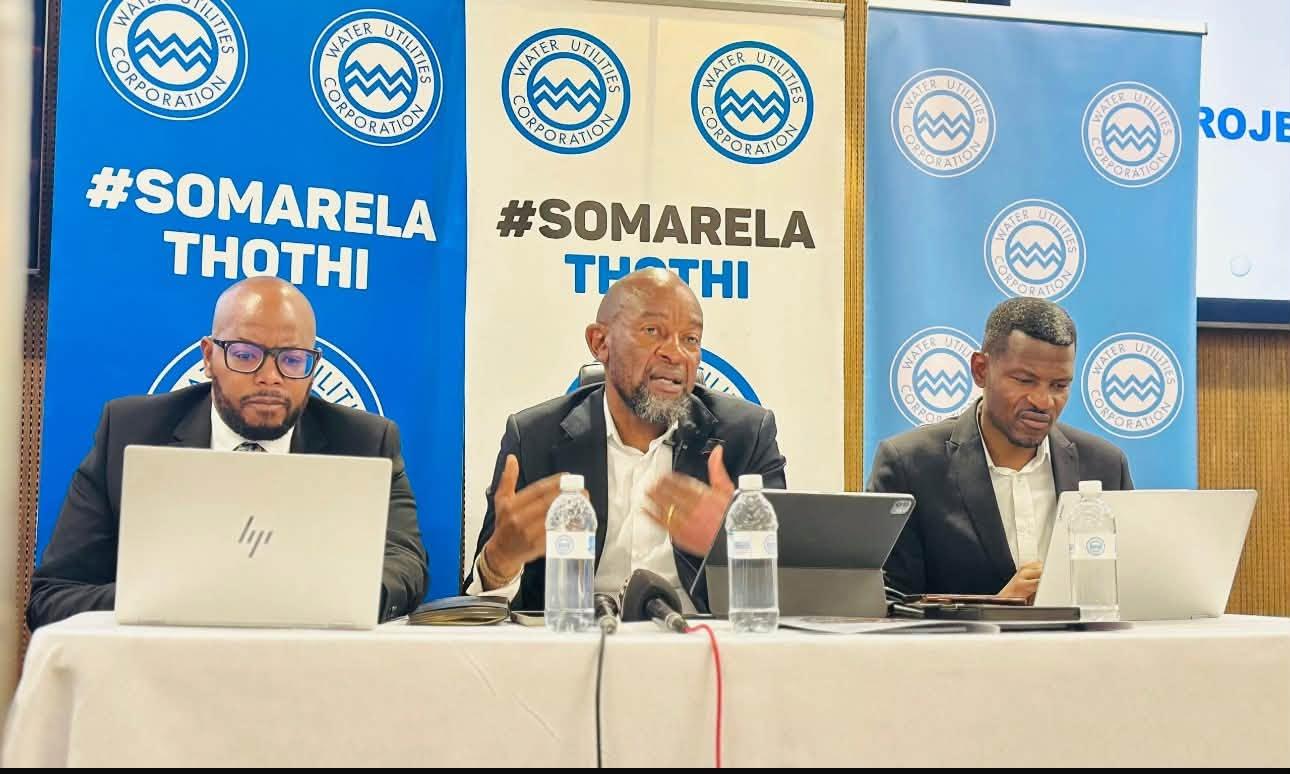
Water Utilities Corporation has announced a 30% reduction in water tariffs Thursday, at a press conference discussing its financial results.
“At Water Utilities Corporation, our responsibility is therefore not simply to provide water and sanitation services, but to ensure that these services are sustainable, reliable, equitable and affordable. And pursuant to the latter the Corporation successfully implemented government aspiration to make water even more affordable by sustainably reducing tariff by 30%,” said Gaselemogwe Senai, Chief Executive Officer of Water Utilities Corporation(WUC).
He said, “Water is an integral part of all actions in building sustainable communities and livelihoods, agriculture, industry, businesses and other economic activities, hence reliable water supply remains fundamental to our country’s continued socio-economic development.”
Senai, discussed WUC’s progress, achievements, setback and plans. In recognition of Botswana’s 60th year of independence, WUC has adopted the theme “60 years of a Nation. Providing Every Drop Towards Progress”.
Despite the expected El Nino seasons for 2026/2027, Senai reassured the public that WUC will meet the national demands for water.
“All WUC major dams remain at healthy storage levels, averaging approximately 90% capacity, providing sufficient reserves to meet domestic water demand under current operating conditions,” added Senai.
Senai reported that there has been a rise in connection requests. WUC has a backlog of 6,595 connections nationwide, a backlog of 45,898 cases for queries and repairs, which is down from 53,000 in April 2026. Gaborone, which accounts for 38% of its customer base, carries 26% of the national queries, which primarily concern stuck meters and pipe leaks.
WUC will start operating 24 hours a day from 1st September 2026, in addition to its self-service channels (website, APP, USSD by 15th August), which are accessible globally.
Senai also reported that it had contracted independent auditors to reassess its results due to a security breach in November 2024.
“This audit was significantly more complex and time-consuming than a normal statutory audit due to the cyber breach incident that the Corporation experienced in November 2024,” he said.
“The Corporation recorded revenue of P2.12 billion during the year compared to P2.16 billion in the previous year. Cost of sales increased to P2.09 billion, largely driven by higher production and operational costs, resulting in a significantly lower gross profit of P28.5 million.” He said.
The increased operating and administrative costs affected WUC’s financial performance.
“The Corporation reported an operating loss of P643.3 million and a net loss after tax of P554.6 million. The Corporation’s total assets rose by 6% to P7.80 billion, compared to P7.34 billion in the previous year, primarily attributable to increases in property, plant and equipment, as well as trade and other receivables. Total liabilities rose by 41% to P3.51 billion, mainly driven by a significant increase in trade payables, tax liabilities, and legal provision.”
Senai also announced the completion of the flagship North-South Carrier (NSC) 2.2 and 2.3 projects, enabling improved water supply security for Gaborone, Greater Gaborone, Lobatse, Kanye, Kweneng, Palapye, Mahalapye, Tswapong South, Shoshong and Rolong cluster villages, benefiting approximately 700,000 people in over 100 villages.
Also complete, is the ‘Expanded the Mmamashia Water Treatment Plant’, doubling treatment capacity from 110 million litres per day to 220 million litres per day, eliminating a critical water supply bottleneck and enhancing drought resilience.
Improved water reliability in the Gaborone-Lobatse corridor through new reservoirs, transmission pipelines and pump stations, increasing supply to Lobatse from 15 million litres per day to 21 million litres per day and improving reliability from 17 to 22 hours per day.
Officials revealed substantial progress on rural water projects, including the Goodhope Water Supply Scheme, which now provides a secure, quality water supply to 21 villages.
WUC announced plans to improve access to treatment water, treatment and sanitation services, including: bulk distribution infrastructure and a wastewater treatment plant with a treatment capacity of 25.6 million litres, one of the country’s largest sanitation facilities.
Also the construction and upgrading of water treatment facilities in Dimajwe, Gweta, Kodibeleng, and Ikongwe to improve water quality and expand supply capacity amongst other planned projects.
WUC also intends to increase water supply nationally and reduce leakages, which stand at average of 45%, with some villages like Kanye and Molepolole recording loses in excess of 55%. It will continue to work on expanding water and sanitation infrastructure.
WUC also rolled out 60,000 smart Prepaid Water Meters at a cost of P500 million. The meters will purportedly help with billing accuracy, reduced water losses, strengthened revenue collection and modernised water utility operations.
WUC is a parastatal and its creditors are affecting its future capacity to perform, thus the CEO encouraged its debtors to settle their debts.
The Botswana government owes P784 million, local councils – P81 million, domestic customers – P648 million and business customers – P159 million.