


Kutlo Motseta
14th August 2026
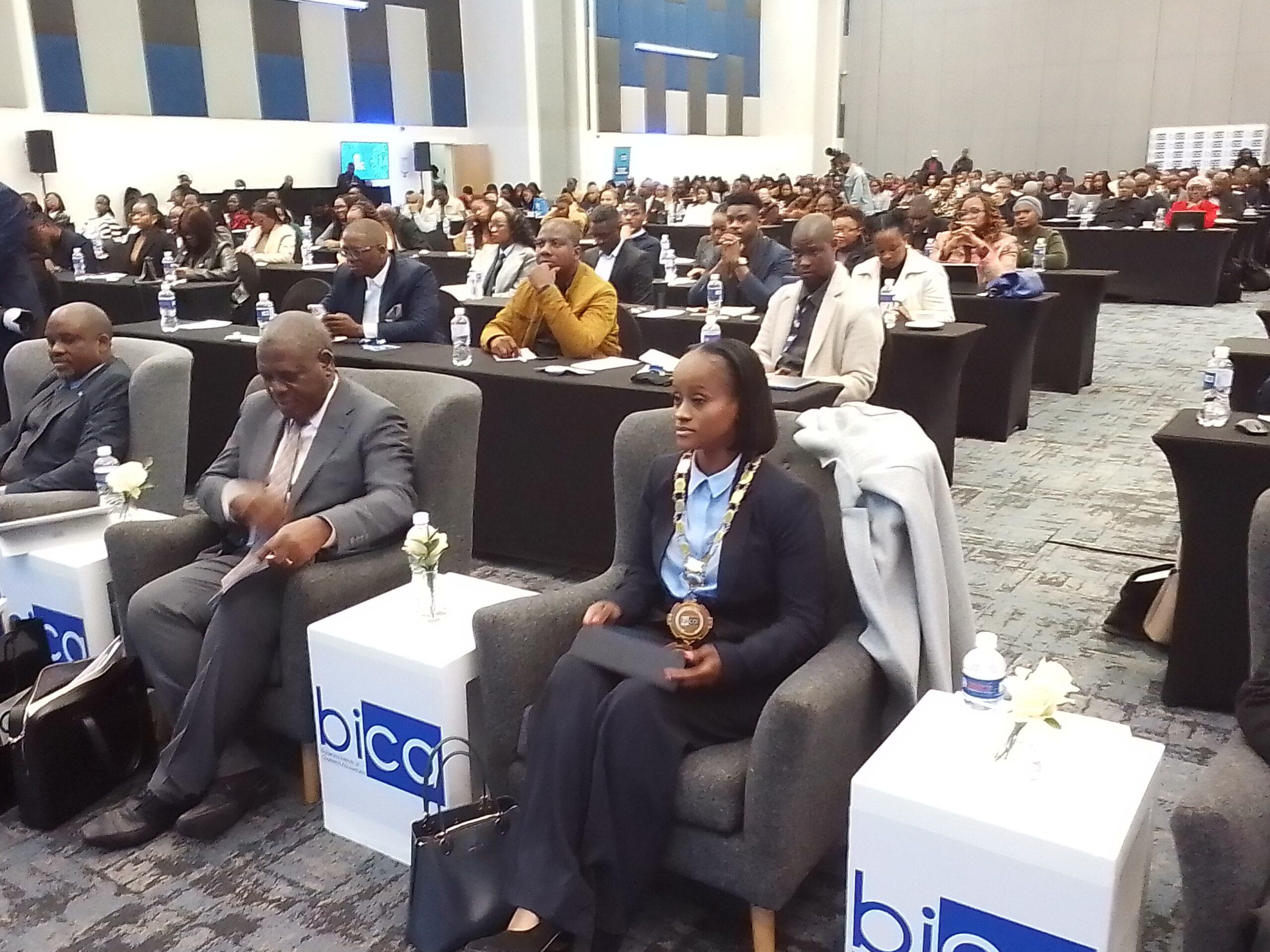
The Botswana Institute of Charted Accountants (BICA) held its ‘BICA International Conference and Dinner Dance 2026’ at the Royal Aria Stadium in Tlokweng.
It was themed “Beyond Disruption: Thriving in a Volatile Global Economy” and featured guest of honour – Deputy Governor Dr Kealeboga S. Masalila – business leaders, academia, policymakers, regulators, professionals and other stake holders.
President of BICA, Ms. Onneile Nelly Maripe, made the welcome remarks and explained the nature of and need to navigate the volatile global economy.
“Global economic uncertainty, changing patterns of trade, technological advancement, geopolitical developments, climate-related risks and the rapid evolution of artificial intelligence are reshaping the way organisations make decisions and prepare for the future,” said Maripe.
Ms. Maripe spoke about the importance of building a diversified, resilient and competitive economy; the role of Botswana’s charted accountants and impact of technology on the economy.
“Our profession is founded on principles of integrity, accountability, transparency and sound judgement. These principles become even more important during periods of uncertainty, because confidence in institutions, financial information and decision-making is fundamental to economic stability,” she added.
The Deputy Governor, Dr. Masalila, discussed the important facets of the domestic and global economy; and how Botswana can remain resilient within it.
“Global commerce volatility and persistent geopolitical tensions continue to reshape trade routes and investment flows, creating inflationary pressures unseen in decades. We are also seeing rapid advances in artificial intelligence, increasingly fragmented global supply chains and heightened climate-related risks … The question before us is no longer whether disruption will occur, it is whether our institutions are sufficiently resilient to withstand it,” he said.
Masalila emphasized the importance of public confidence and the elements that stabilize the economy, from the banking system, the value of money, financial institutions to the enablement of businesses and the need for households to make economic decisions with certainty.
“Without confidence, markets hesitate, Investment slows, consumption weakens and growth becomes increasingly difficult to sustain. This is why monetary stability remains central to national economic resilience,” said Masalila.
“Botswana has, over many years, earned a reputation for prudent macroeconomic management, sound institutions and credible policy frameworks. These strengths have enabled our economy to weather successive global shocks more effectively than many comparable economies,” he added.
The deputy governor spoke about Botswana’s global interdependence, navigating the world economy, the impact of inflation and price stability.
He said, “Botswana remains deeply connected to developments beyond our borders. As a small, open economy, fluctuations in commodity prices, global interest rates, inflation abroad, geopolitical developments and changes in international financial markets inevitably influence domestic economic conditions. Our challenge, therefore, is not to isolate ourselves from global developments, which is an impossible task, but rather to build institutions capable of responding effectively to them.”
“While inflationary pressures have moderated in many jurisdictions compared to their recent peaks, uncertainty remains elevated. Inflation erodes purchasing power, it distorts investment decisions, it disproportionately affects lower-income households, perhaps most importantly, it undermines confidence. Maintaining price stability therefore remains one of the Bank of Botswana’s primary mandates,” he added.
Dr. Masalila further spoke about the relationship between the economy, price stability and liquidity.
“Price stability is about achieving a particular statistical outcome and creating an environment within which businesses can invest with confidence, households can plan for the future and financial institutions can allocate capital efficiently. Closely linked to price stability is liquidity. An efficient financial system requires adequate liquidity to facilitate lending, support productive investment and enable businesses to expand … Insufficient liquidity can constrain credit, reduce investment and weaken economic activity … You are custodians of financial integrity, you strengthen corporate governance you enhance transparency, you improve decision-making and ultimately, you reinforce public confidence in our institutions,” he added.
The deputy governor discussed domestic and global economic resources; specifically, local human resources, leadership in the midst of artificial intelligence and the importance of Botswana remaining economically resilience. He said the above must be considered holistically, taking into consideration stakeholders such as government, the business sector, financial institutions, academia and every Botswana resident.
“Technology can enhance productivity, but it cannot replace professional judgement. Automation can improve efficiency, but it cannot substitute ethical leadership. The future resilience of our economy will increasingly depend upon broadening our productive base, strengthening the private sector, encouraging entrepreneurship and deepening regional and international trade. Financial stability plays an essential enabling role in this transformation,” he said.
The deputy governor remains very confident in Botswana’s economy.
“Resilience is not measured by the absence of shock, it is measured by how effectively we adapt when those shocks inevitably occur … Botswana has demonstrated resilience before, there is every reason to believe we can continue to do so,” he said.