

24th January 2026
Own Correspondent
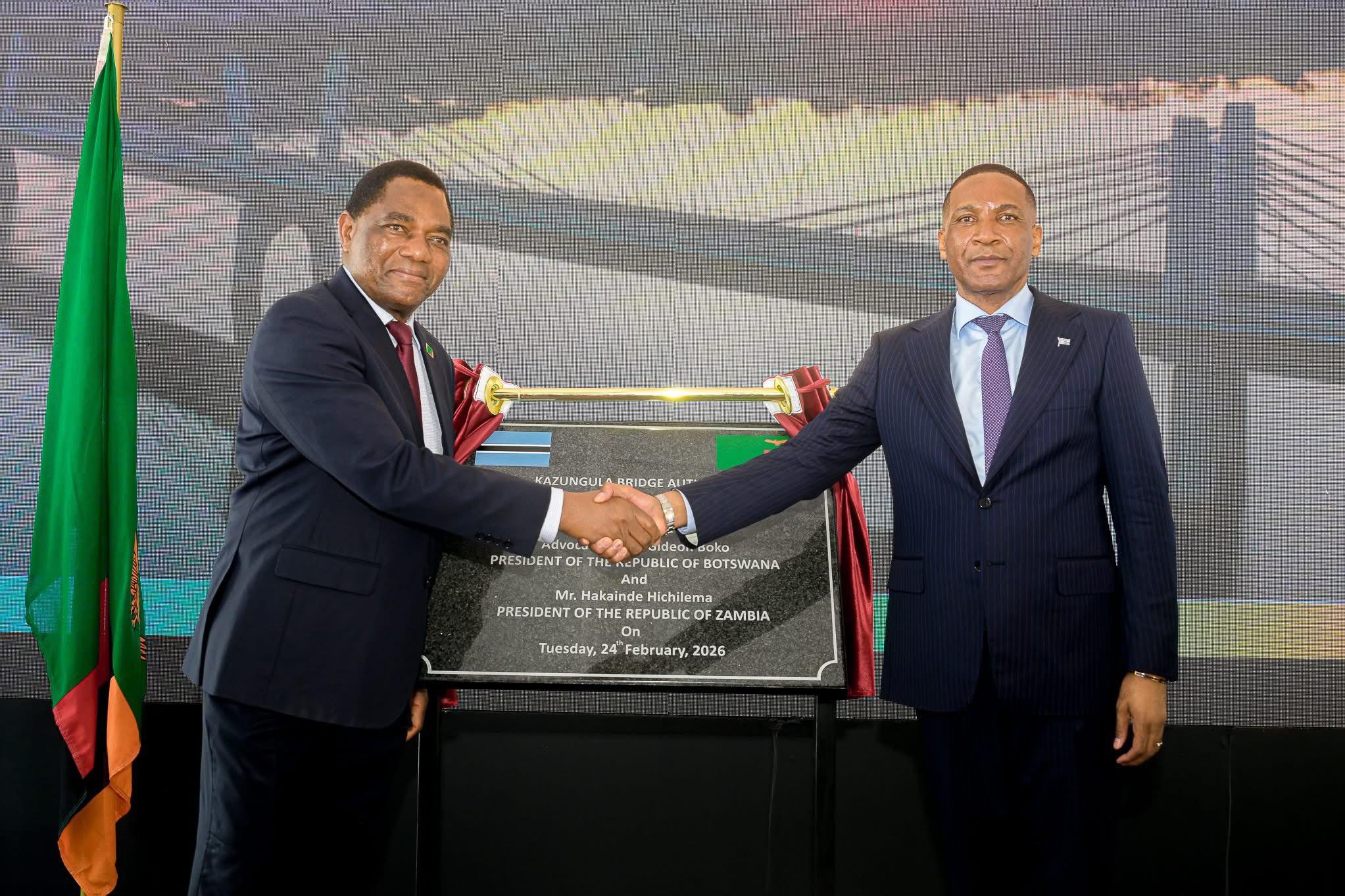
President Duma Boko and President Hakainde Hichilema of Zambia stood united in purpose on the wet shores of the scenic Chobe and Zambezi Rivers, to officially launch the Kazungula Bridge Authority (KBA) Tuesday.
The Kazungula Border, which is a very strategic river crossing that played a key role in the political liberation of southern Africa, is now being transformed into a model for the continent’s economic liberation and will remain open 24 hours a day to facilitate cross border trade.
Botswana President Advocate Duma Gideon Boko emphasised, “We are not merely commissioning an Authority; we are consolidating a partnership.”
He added that the new institution embeds governance within opportunity and positions both nations to fully benefit from the African Continental Free Trade Area.
Officials revealed that the Kazungula Bridge started operation in May 10, 2021. Built at a cost of $269 million, the uniquely designed 923-metre-long road and rail bridge replaces the ancient ferry pontoon system which had proven not only inefficient but very slow and highly unreliable.
This was an unprecedented development, that we greatly applaud. The bridge sits over a confluence of two rivers – where Chobe River meets the Zambezi River; and a quadripoint where Botswana, Namibia, Zambia and Zimbabwe converge on the Zambezi River. The bridge is a valuable asset not only to our two countries but to Africa as a whole.
Noah Salakae, Minister of Transport and Infrastructure, said “The Kazungula Bridge stands not only as a physical link between our two countries, but also as a key component of the North-South Corridor (NSC), a vital trade route within the SADC Region and an important conduit for regional integration and economic development, benefiting countries such as Democratic Republic of Congo, Malawi, Mozambique, Namibia, South Africa, Tanzania as well as Zimbabwe.”
He said, “The NSC accounts for approximately eighty four percent (84%) of regional freight traffic, primarily driven by trade activities in Zambia, the Democratic Republic of Congo and South Africa.”
A significant portion of this traffic originates from the Port of Durban, which handles nearly sixty four percent (64%) of all container movements within the region and the Gauteng Province of South Africa, encompassing Johannesburg and Pretoria, which serves as the region’s principal centre for manufacturing, warehousing and distribution.
The NSC is the corridor of choice for the mining, agriculture and manufacturing sectors in the region owing to its balanced import-export flow, competitive costs, and overall efficiency.
The Kazungula Bridge is expected to act as a catalyst for economic transformation, unlocking new investment opportunities and reinforcing the Kazungula One Stop Border’s position as a key gateway for regional trade and connectivity.
The KBA will help streamline cross-border procedures, resulting in reduced clearance times and lower trade costs and enhanced competitiveness of Botswana’s exports and imports.
The two countries have agreed to jointly sponsor the construction and operation of the bridge infrastructure. Botswana will host the Authority’s headquarters, while Zambia will hold the position of Executive Director. The establishment of the Authority comes five years after the Kazungula Bridge was first commissioned between the two nations.
Charles Milupi, Ministry of Infrastructure, Housing and Urban Development, “Since the opening of the Kazungula Bridge in May 2021, the number of trucks crossing the bridge has significantly increased – from an average of 214 trucks per day in 2021 to 491 trucks per day as at December, 2025.”
He said, “We intend to move quickly from a one stop border post to a non-stop border post by leveraging technology. This is the vision given to us by your Excellencies.”
The Kazungula Bridge will operate as a model for efficient management, achieve long term growth and sustainability, to benefit not only the region but Africa as a whole.