

10th November 2025
Sello Motseta
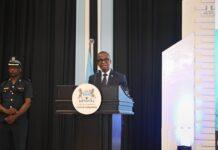
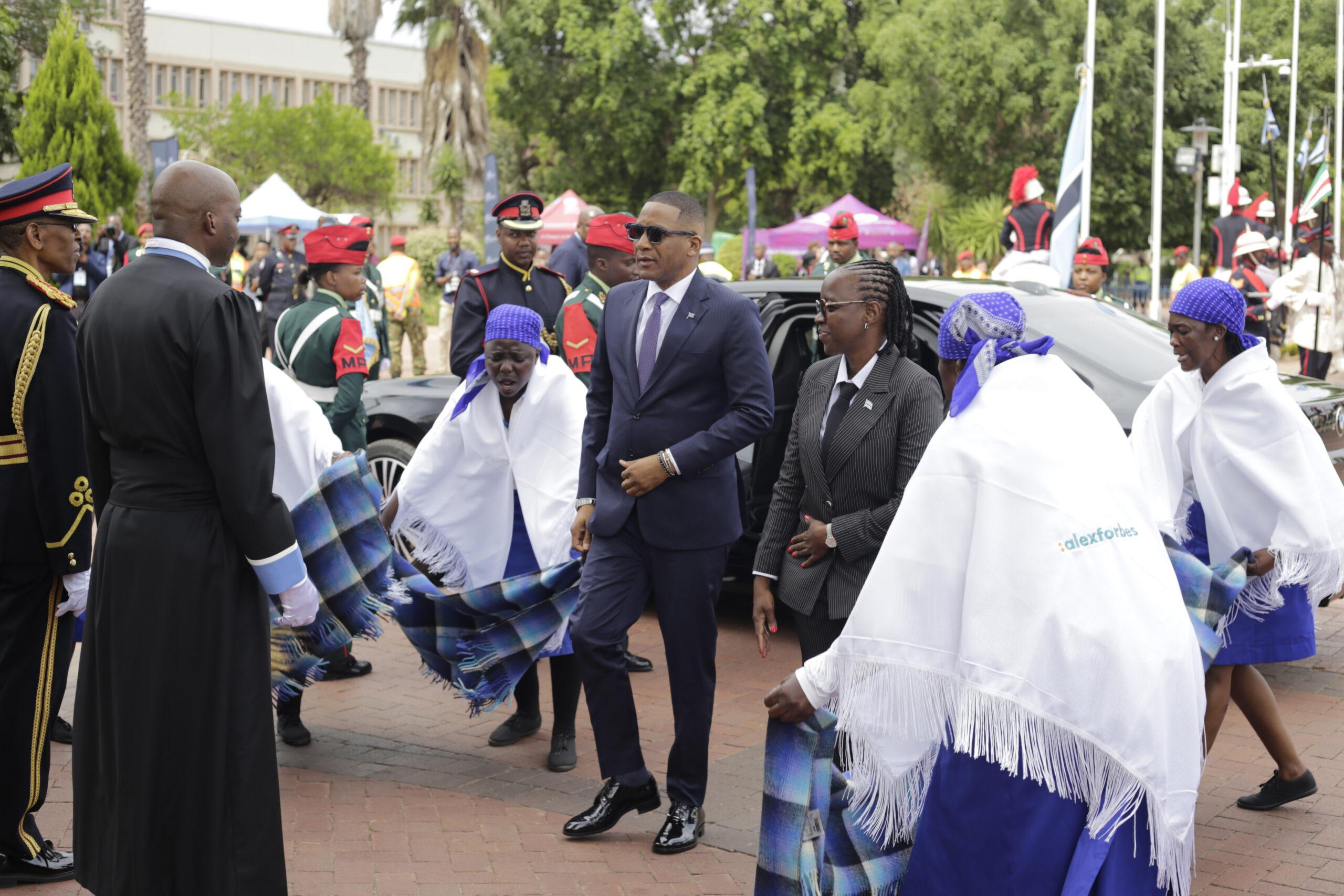
A buoyant President Advocate Duma Gideon Boko used the State of Nation Adress Monday to remind Batswana that the Umbrella for Democratic Change(UDC) government had entered office with strained fiscus, depleted coffers, employees owed, contractors owed, farmers owed, a debt of hope to the people, and resentment by its defeated rivals.
He also continued to riducle the media saying that the entire press corps of this country was aroused, mobilised and weaponised against the UDC. Boko also announced the launch of controversial Impact Citizenship programme designed to allow investor to buy Botswana citizenship.
“Acres of newspaper space and extended amounts of airplay were devoted to spreading the chronically prejudiced views of our adversaries and detractors,” said President Advocate Duma Gideon Boko, who was not in a very conciliatory mood.
He said, “The UDC government entered office with strained fiscus, depleted coffers, employees owed, contractors owed, farmers owed, a debt of hope to the people, and resentment by its defeated rivals.”
In an implicit aside to critics who accuse him of being all talk and no action he identified early successes of his administration and appeared to suggest his administration deeply cared about the plight of less priviledged members of society unlike the administration of his predecessors.
He said, “We promised to increase living allowance for tertiary students to P2 500 – we have during this economic hardship delivered, in this first year for the hardest hit segment of the student community, a very significant increase on the Technical, Vocational Education and Training (TVET) allowance from P300.00 to P1 900.”
Although, Boko has been quiet about agriculture he used the state of the nation to reveal that central to his vision is a renewed focus on livestock production, aimed at increasing the national herd from an estimated present level of 1.7 million to 5 million by 2030.
Livestock contributes a larger proportion of Botswana’s agricultural GDP, anchoring rural livelihoods. Yet the sector faces mounting challenges of disease outbreaks, recurring droughts, 10 poor land management and production inefficiencies such as low calving rates, high mortality rates and lack of business development, which have eroded productivity and degraded the agricultural value chain.
In response to this decline, Government launched in August 2025 a programme aimed at boosting beef sector productivity through extension support. Services advanced by this programme include animal health inspections, reproductive diagnostics, artificial insemination and farmer training in sustainable livestock management.
“In Ngamiland government has recently launched the Direct Cattle Procurement Scheme where farmers are paid instantly. This scheme will greatly benefit the Ngamiland farmers who for the longest time have not had market access. On Milk Production, we have developed a focused strategy for the Dairy Sector through Milk Valley, a wholly owned subsidiary of the Botswana Development Corporation,” said Boko.
He said, “For several years, progress was stalled due to the prevalence of foot and mouth 11 disease in neighbouring countries, which prevented the importation of biological assets. Currently, our local production capacity for milk and related products stands at 13%, and we are targeting an increase to over 60% by next year. 49. Recently, government completed a mission to Brazil to secure the importation of at least 1 000 Girolando cattle to kickstart this expansion.”
Officials are now finalising necessary import protocols and negotiating technical partnership agreements with sellers to ensure successful commencement of the project.
These partnerships will allegedly support Botswana over the next two years by facilitating skills transfer to Batswana, who will be directly employed on the project. Recognising that feed availability is essential for successful dairy operations, we are finalising out-grower programme guidelines to engage contract farmers around Lobatse region in support of this project.
Botswana is identifying other regions across the country for potential expansion once a sustainable business model is firmly established. The 2024/25 season saw a 34.2% increase in planted area compared to the previous season yielding an estimated 144 000 tonnes in production, a massive improvement when compared to only 39 795 tonnes in the 2023/24 season.
A key driver of NDP12, emphasising economic diversification, job creation, and sustainable growth is the Botswana Economic Transformation Programme (BETP). BETP will accelerate Botswana’s transition into a high-income economy with per capita income of P200 000 by 2036.
Boko promised to implement the payment of the minimum wage of P4000 by July 2025. government completed a mission to Brazil to secure the importation of at least 1 000 Girolando cattle to kickstart this expansion. We are now finalising the necessary import protocols and negotiating technical partnership agreements with sellers to ensure successful commencement of the project.
These partnerships will support us over the next two years by facilitating skills transfer to Batswana, who will be directly employed on the project. 50. Recognising that feed availability is essential for successful dairy operations, we are finalising out-grower programme guidelines to engage contract farmers around Lobatse region in support of this project.
Additionally, the UDC Government is identifying regions across the country for potential expansion once a sustainable business model is firmly established. The 2024/25 season saw a 34.2% increase in planted area compared to the previous season yielding an estimated 144 000 tonnes in production, a massive improvement when compared to only 39 795 tonnes in the 2023/24 season.
Tthe Government has reportedly engaged in a rigorous process to develop 12th National Development Plan (NDP 12). NDP 12 emphasises inclusive growth built through a private sector-led economy.
It buttresses ambitions that refocus the development processes to drive towards our True North; a definition of our core principles and enduring ideals of our government for ‘a high – income Botswana that is digitally enabled, export driven and economically diversified, where every citizen is employed, empowered and fulfilled.’
A key driver of NDP12, emphasising economic diversification, job creation, and sustainable growth is the Botswana Economic Transformation Programme (BETP). BETP will accelerate Botswana’s transition into a high-income economy with per capita income of P200 000 by 2036.
Our mining sector is evolving rapidly, with new strategic minerals entering the fold alongside diamonds. The Letlhakane Uranium Project, operated by Lotus Resources, is undergoing a major infill drilling campaign to refine its resource and support a P6.2 billion mine plan targeting 3 million pounds of uranium annually.
In Kanye, Giyani Metals is developing the K. Hill Battery-Grade Manganese Project, having secured a mining license and a Special Economic Zone Investor License. The project aims to supply high-purity manganese for electric vehicle batteries, aligning Botswana with global clean energy supply chains. 65. Iron ore is also becoming an important resource in the diversification mix, with projects like the Ngamiland Iron Ore Project set to boost Botswana’s steel industry.
“These developments signal a broader shift toward industrial minerals, green steel, and value-added beneficiation. Together, uranium, manganese, and iron ore form an emerging triad of opportunity in Botswana’s mining renaissance,” said Boko.
Botswana is endowed with a diverse range of mineral resources suitable for small scale mining (SSM) including gold, copper, industrial minerals and graphite. Globally, small scale mining plays a critical role in livelihoods, supporting over 45 million individuals directly.
Botswana Geoscience Institute is also developing a comprehensive and pragmatic Small-Scale Mining (SSM) framework for Botswana. Its overall aim is to facilitate citizen economic empowerment through viable and environmentally sustainable SSM activities.
“One of the projects to debut the Presidential Youth Empowerment Campaign is the Climate-Smart Horticulture Development Programme which is a targeted skilling and capacity building programme to develop over 500 small-hold farmers organised in clusters,” said Boko.
To help young farmers meet buyer specifications, scale production and access start-up funding, a horticulture specific fund in partnership with financial institutions will be established.
Through collaborative efforts of various partnership organisations, beneficiaries will be facilitated to access both local and export markets through the programme.
Boko revealed corruption remains a persistent challenge to Botswana’s socio economic development and governance. “The ongoing forensic audit on Government expenditure, and functional efficacy of 38 existing systems and institutions over a ten-year period, will undoubtedly culminate in strengthening governance. It will foster a culture of transparency and accountability across the economy. Completion of the audit is scheduled for March 2026,” said Boko.
In recognition of the need for a modern, independent anti corruption institution, the government has prioritised review of the Corruption and Economic Crime Act (CECA) of 2013.
The revised Draft Bill, currently under legal vetting, proposes to grant DCEC greater operational independence, including a redefined reporting structure and enhanced protections for the office of the Director General.
The CECA Draft Bill will be tabled for approval during current sitting of Parliament.