

24th June 2026
Sello Motseta
The prolonged weakness in global diamond demand, heightened geopolitical tensions, evolving trade arrangements, and persistent uncertainty in the global economy have continued to weigh down on Botswana’s economic performance and fiscal position.
Higher energy and food prices will increase the inflationary pressures in 2026. Domestic inflation is therefore expected to increase sharply from 2.7% in 2025 to 9% in 2026, but will revert within 3 – 6% objective range into the medium term.
Real GDP contracted by 0.7% in 2025, an improvement from a contraction of 2.8% in 2024. But the economy is expected to rebound to 3.1% in 2026 and 5.4% in 2027.
These developments have exposed, once again, the vulnerabilities associated with a narrow export base and at a time when our buffers have been substantially eroded.
“Notably, lower mineral revenue has put pressure on government finances and the foreign exchange reserves, reducing the policy space available to respond to economic shocks. Therefore, the importance of policy reforms to restore fiscal sustainability and rebuild buffers,” said Lesego C Moseki, Governor of the Bank of Botswana(BOB).
He said, “This diagnosis, therefore, underscores the urgency for the country to accelerate economic transformation. We at the Bank do see a way out in this regard and are steadfast in supporting beneficial reforms and structural transformation.”
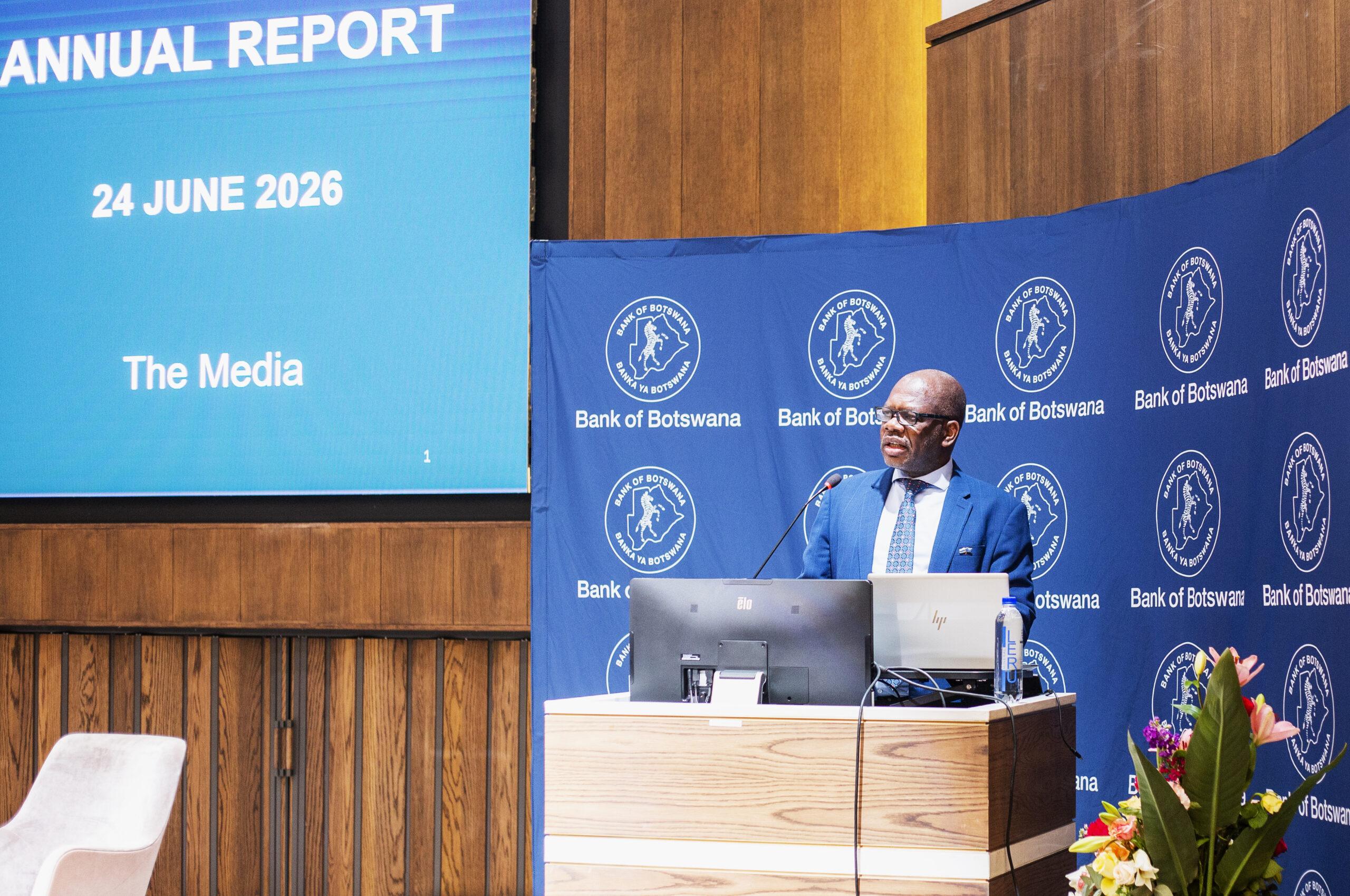
Moseki made these remarks when launching the Bank of Botswana(BOB) Annual Report which is published in compliance with the Bank of Botswana Act and, as a statutory requirement.
“It also demonstrates our commitment to transparency and public education in relation to our mandates, manner of execution and performance outcomes; which are a big part of the Bank’s value creation,” said Moseki.
He said, “In essence, reporting back as well as enabling feedback and dialogue on the stewardship of the public goods, licence to operate banking business and resources entrusted to the Bank.”
The Bank of Botswana assumes responsibility for a whole host of functions including, price and financial stability; currency management; management of the foreign exchange reserves as well as maintenance of effective and trusted payments systems.
These collapse into preservation of integrity of national currency and trust in the domestic financial system. It involves an obligation to ensure the central bank put in place mechanisms, frameworks and support services that transmit attainment of our mandates to long-term, inclusive and sustainable increase in incomes and welfare for the nation and Batswana.
Officials stressed that despite the current challenges, Botswana’s economic fundamentals remain sound. The country continues to benefit from strong institutions, a stable financial system, prudent macroeconomic stewardship and management, and a longstanding reputation for policy credibility and good governance that underpin investment grade sovereign credit rating.
“These strengths have enabled Botswana to navigate difficult periods in the past and continue to provide a solid foundation for recovery and long-term prosperity,” said Moseki.
It is believed the current environment creates an opportunity to accelerate initiatives strengthening domestic productive capacity, deepen export diversification, enhance participation in regional and global value chains, and unlock new sources of growth.
Diamond revenues have engendered an endemic leisure fare attitude in this country, where there is no sense of urgency in Botswana’s approach to implementing economic transformative initiatives. It is believed that the attitude to service delivery must change drastically across the economy.
Dr Matlhodi Serero Acting Director – Research and Financial Stability Department, said “The Bank is moving with renewed purpose into the future with a new Strategic Plan for 2026 –2028.”
He said, “Mining GDP contracted by 14% in 2025 down from a larger contraction of 23.9% in 2024. Non-Mining GDP growth decelerated to 2% in 2025, compared to a higher growth of 3.1 percent in 2024.”
Net after-tax profit of local banks declined by 10.1 percent from P4.1 billion in 2024 to P3.7 billion in 2025. The fall was mainly due to a 52 percent increase in interest expense during the period. Despite the fall, all banks were profitable except one bank, which made a loss.
Otsile Moduka, CFA Acting Director, Financial Markets Department, said “The prolonged weakness in the diamond sector has put pressure on foreign exchange of reserves.”
He said, “Reserves adequacy concerns (lower import cover) leave the country vulnerable to shocks SACU revenues have increasingly become an important source of foreign earnings. Adjustments made to the Pula exchange rate parameters have contributed to reducing the pace of attrition.”
Officials revealed that there is a risk that unchecked withdrawals could lead to depletion of foreign exchange reserves. A robust and diversified SAA have supported strong market gains There is need to focus on rebuilding of foreign exchange reserves to be prepared for future shocks.
Daniel Neo Loeto, Bank of Botswana, Chief Financial Officer, said “Net income of P5.2 billion in 2025, compared to net income of P5.8 billion in 2024. Net income was mainly on account of net realised fair value gains of P5.6 billion and P1.5 billion on profits on foreign exchange deals in the current year reduced by P2.6 billion net unrealised fair value losses.”
He said, “After transfer of P2.9 billion from Fair Value Reverse(FVRR) and P510 million to the Currency Revaluation Reserve, respectively, P7.6 billion was available to distribute(2024: P4.1 billion) Distribution comprised: • P7.29 billion to Government • P212 million to FVRR and P150 million retained.”
Bank of Botswana holds assets totalling P56.6 billion in 2025 (P54.2 billion in 2024) as foreign exchange reserves decreased marginally by 1.5 percent from P48.1 billion to P47.4 billion.
There was a marginal decrease in foreign exchange reserves due to net effect of continued provision of foreign exchange, external borrowing and adjustments to the exchange rate parameters. The Balance on Government Investment Account increased from P251.3 million to P846 million.
As at 22 June 2026 GIA – P1.2 billion Foreign Exchange Reserves – P58.4 billion. The Bank distributed P7.3 billion (2024: P4.1 billion) to Government after a transfer of the unrealised fair value losses and the unrealised currency gains to the Fair Value Revaluation and Currency Revaluation Reserves, respectively.
Foreign exchange reserves decreased to about 1.5 percent, mainly on account of adjustments to the exchange rates parameters, foreign loans and continued provision of foreign exchange to the economy during 2025, the current level is P58.4 billion as at 22 June 2026, equivalent to 6.7 months of import cover compared to 5.5 months of import cover at the end of 2025.
The country needs to do all in its power to diversify the economy and rebuild its buffers to levels that would enable the country to deal with any future challenges like droughts, international financial crisis or pandemics.